
Materials & grades
1040 / C40 / EN8 (080M40) medium-carbon steel: equivalents 40C8 and S40C
1040, C40, EN8 (080M40), 40C8 and S40C are closely related medium-carbon steels with about 0.40 % carbon, used for shafts, axles, studs and forgings that need more strength than mild steel. They are close equivalents rather than one material: manganese limits and the specified mechanical properties differ by standard.
Names by standard
What it is called in each region
| Region | System | Designation | Standard | Match |
|---|---|---|---|---|
| USA | AISI/SAE | 1040 | SAE J403; ASTM A29 / A108 | Same material |
| UNS | G10400 | — | Same material | |
| UK | BS 970 | 080M40Wider manganese range (0.60–1.00 %) than 1040 or C40. BS 970 has been withdrawn in favor of European standards, but 080M40 remains a common UK stock name. | BS 970 | Closest equivalent |
| BS 970 legacy EN series | EN8superseded name for 080M40, still the most searched UK name. | — | Closest equivalent | |
| BS 970 | 080A40Composition-specified (A) variant listed by Saarstahl against C40E. | BS 970 | Closest equivalent | |
| EU | EN 10027-1 name | C40Same carbon range as 1040 (0.37–0.44 %) with manganese 0.50–0.80 %. | EN ISO 683-1 (formerly EN 10083-2) | Equivalent |
| EN 10027-2 number | 1.0511Material number of C40. | EN ISO 683-1 | Equivalent | |
| EN 10027-1 name | C40E (1.1186) / C40R (1.1189)Variants with tighter phosphorus and sulfur (E) or a controlled sulfur range for machinability (R). | EN ISO 683-1 | Equivalent | |
| DIN (legacy) | Ck40 / Cm40Superseded German names for C40E and C40R. | — | Equivalent | |
| India | IS 1570 | 40C8Carbon 0.35–0.45 %, manganese 0.60–0.90 %. | IS 1570 (Part 2/Sec 1) | Closest equivalent |
| IS 1570 (old designation) | C40Superseded Indian name for 40C8; not the same document as the European C40. | — | Closest equivalent | |
| Japan | JIS G 4051 | S40CCarbon 0.37–0.43 %, slightly narrower than 1040. | JIS G 4051 | Closest equivalent |
On equivalence
- EN8 is the old BS 970 (original edition) name for 080M40. Its manganese range (0.60–1.00 %) is wider than 1040's (0.60–0.90 %) and C40's (0.50–0.80 %), so EN8 is closest to 1040, not identical.
- Some UK stockists list C45 and 1045 among EN8 equivalents. EN8's carbon range (0.36–0.44 %) matches 1040 and C40; 1045 and C45 are a step higher in carbon.
- EN8D (080A42, 0.40–0.45 % C) sits between 1040 and 1045 and is a different grade from EN8.
- C40, C40E and C40R share carbon, manganese and mechanical requirements; they differ in phosphorus and sulfur limits.
- Indian 40C8 under IS 1570 fixes only carbon and manganese; phosphorus, sulfur and silicon come from the product standard ordered.
- S40C (JIS) has a slightly narrower carbon range (0.37–0.43 %). MISUMI's comparison maps S40C to 1039, 1040 and 1042.
Chemical composition
Composition limits, mass %
| Element | 1040USA · SAE J403 | 080M40 (EN8)UK · BS 970 | C40 (1.0511)EU · EN 10083-2 (now EN ISO 683-1) | C40E (1.1186)EU · EN 10083-2 (now EN ISO 683-1) | 40C8India · IS 1570 (Part 2/Sec 1):1979 | S40CJapan · JIS G 4051:2023 |
|---|---|---|---|---|---|---|
| C | 0.37–0.44 | 0.36–0.44 | 0.37–0.44 | 0.37–0.44 | 0.35–0.45 | 0.37–0.43 |
| Si | — | 0.10–0.40 | ≤0.40 | ≤0.40 | — | — |
| Mn | 0.60–0.90 | 0.60–1.00 | 0.50–0.80 | 0.50–0.80 | 0.60–0.90 | — |
| P | ≤0.030 | ≤0.050 | ≤0.045 | ≤0.030 | — | — |
| S | ≤0.050 | ≤0.050 | ≤0.045 | ≤0.035 | — | — |
| Cr | — | — | ≤0.40 | ≤0.40 | — | ≤0.20 |
| Ni | — | — | ≤0.40 | ≤0.40 | — | — |
| Mo | — | — | ≤0.10 | ≤0.10 | — | — |
| Cr+Mo+Ni | — | — | ≤0.63 | ≤0.63 | — | — |
| Cr+Ni | — | — | — | — | — | ≤0.35 |
Mechanical properties
Strength and hardness
| Condition | Tensile strength | Yield strength | Elongation | Hardness |
|---|---|---|---|---|
| Hot rolled (1040)Estimated minimum, bars 19–32 mm (3/4–1-1/4 in), SAE J1397 basisSAE J1397 estimates as published by Guanyu and ICAST | 76 ksi (524 MPa) | 42 ksi (290 MPa) | 18 % | 149 HB |
| Cold drawn (1040)Estimated minimum, bars 19–32 mm (3/4–1-1/4 in), SAE J1397 basisSAE J1397 estimates as published by Guanyu and ICAST | 85 ksi (586 MPa) | 71 ksi (490 MPa) | 12 % | 170 HB |
| Normalized (EN8 / 080M40)Specified minimum as published by a UK supplier; section size not statedTachart 080M40 | ≥79.8 ksi (≥550 MPa) | ≥40.6 ksi (≥280 MPa) | 16 % | 152–207 HB |
| Hardened and tempered, 'R' condition (EN8 / 080M40)Limiting ruling section up to 19 mmSmiths Metal Centres EN8 datasheet | 102–123 ksi (700–850 MPa) | ≥67 ksi (≥465 MPa) | 16 % | 201–255 HB |
| Normalized +N (C40 / C40E)Specified minimum, d 16–100 mmEN 10083-2 as tabulated by Roymech and Saarstahl | ≥79.8 ksi (≥550 MPa) | ≥42 ksi (≥290 MPa) | 17 % | — |
| Quenched and tempered +QT (C40 / C40E)Specified, d 16–40 mmEN 10083-2 as tabulated by Roymech and Saarstahl | 91–113 ksi (630–780 MPa) | ≥58 ksi (≥400 MPa) | 18 % | — |
| Hot rolled or normalized (40C8)Specified range, ruling sections up to 150 mmIS 1570 (Part 2/Sec 1):1979, Table 2 | 84–99 ksi (580–680 MPa) | — | 18 % | — |
| Hardened and tempered (40C8)Specified, limiting ruling section 30 mmIS 1570 (Part 2/Sec 1):1979, Table 4 | 102–123 ksi (700–850 MPa) | ≥69.6 ksi (≥480 MPa) | 17 % | — |
In practice
Behavior, heat treatment and uses
Characteristics
- Medium carbon gives noticeably higher strength and wear resistance than mild steel, with moderate toughness.
- Limited hardenability: only fairly small sections harden through when quenched; larger sections harden at the surface only.
- Responds well to flame or induction hardening for a hard surface over a normalized core.
- Weldable with care: preheat, low-hydrogen consumables and post-weld stress relief are recommended, and welding of hardened material is avoided.
- Machines well in the normalized or hot-rolled condition.
Heat treatment
- Normalizing: about 850–890 °C (1560–1630 °F), cool in air (Saarstahl, C40E); AZoM gives about 900 °C (1650 °F) for 1040.
- Soft annealing: about 680–710 °C (1255–1310 °F), furnace cool (Saarstahl, C40E).
- Hardening: about 830–870 °C (1525–1600 °F), quench in water or oil (Saarstahl, C40E); AZoM gives 844–899 °C (1550–1650 °F) with a water quench for 1040.
- Tempering: about 550–660 °C (1020–1220 °F) for quenched-and-tempered (+QT) properties (Saarstahl); lower tempering temperatures give higher strength.
- Stress relieving: about 594 °C (1100 °F) for 1040 (AZoM).
Typical uses
- Shafts, axles and spindles
- Studs, bolts and pins
- Connecting rods, couplings and crankshafts
- Gears and sprockets that are flame or induction hardened
- General forgings and machined parts
Carbon steels
Similar grades compared
| Grade | C % | Mn % | Cr % | Ni % | Tensile strength, first listed condition |
|---|---|---|---|---|---|
| 1040 / C40 / EN8 | 0.37–0.44 | 0.60–0.90 | ≤0.40 | ≤0.40 | 76 ksi (524 MPa) |
| 1030 / C30 | 0.28–0.34 | 0.60–0.90 | ≤0.40 | ≤0.40 | 68 ksi (470 MPa) |
| 1035 / C35 | 0.32–0.38 | 0.60–0.90 | ≤0.40 | ≤0.40 | 73 ksi (500 MPa) |
| 1045 / C45 | 0.43–0.50 | 0.60–0.90 | ≤0.40 | ≤0.40 | 82 ksi (565 MPa) |
| 1050 / C50 | 0.48–0.55 | 0.60–0.90 | ≤0.40 | ≤0.40 | 90 ksi (620 MPa) |
| 1055 / C55 | 0.50–0.60 | 0.60–0.90 | ≤0.40 | ≤0.40 | 94 ksi (650 MPa) |
| 1008 | ≤0.10 | 0.30–0.50 | — | — | 44 ksi (303 MPa) |
| 1010 / C10E | 0.08–0.13 | 0.30–0.60 | ≤0.30 | — | 46 ksi (320 MPa) |
| 1015 / C15E | 0.13–0.18 | 0.30–0.60 | ≤0.30 | — | 49 ksi (340 MPa) |
| 1018 | 0.15–0.20 | 0.60–0.90 | ≤0.20 | — | 58 ksi (400 MPa) |
Composition from the US standard where one exists, otherwise the first standard listed on each grade's page. Strength conditions differ between grades; open a grade's page for its full table.
Questions answered
Common questions
What is the equivalent of EN8 steel?
EN8 is the old British name for 080M40. Its closest equivalents are AISI/SAE 1040, European C40 (1.0511), Indian 40C8 and Japanese S40C. They are close equivalents, not identical: EN8 allows up to 1.00 % manganese.
Is EN8 the same as C45 or 1045?
No. EN8 has 0.36–0.44 % carbon, which matches 1040 and C40. C45 and 1045 have 0.42–0.50 % and 0.43–0.50 % carbon, so they are slightly stronger and harden more readily. Some suppliers list them as substitutes, but they are different grades.
Is 1040 the same as C40?
They are close equivalents with the same carbon range (0.37–0.44 %). C40 has lower manganese (0.50–0.80 % against 0.60–0.90 %), and EN ISO 683-1 specifies mechanical properties by condition and size, which SAE J403 does not.
What is the difference between EN8 and EN8D?
EN8 is 080M40 (0.36–0.44 % C). EN8D is 080A42, a separate grade with 0.40–0.45 % carbon and 0.70–0.90 % manganese, so it is slightly higher in carbon.
Can EN8 be hardened?
Yes. It can be quenched and tempered, but through-hardening is limited to small sections. For wear surfaces it is usually flame or induction hardened.
From the GV Steels range
Products listed with 1040 / C40 / EN8
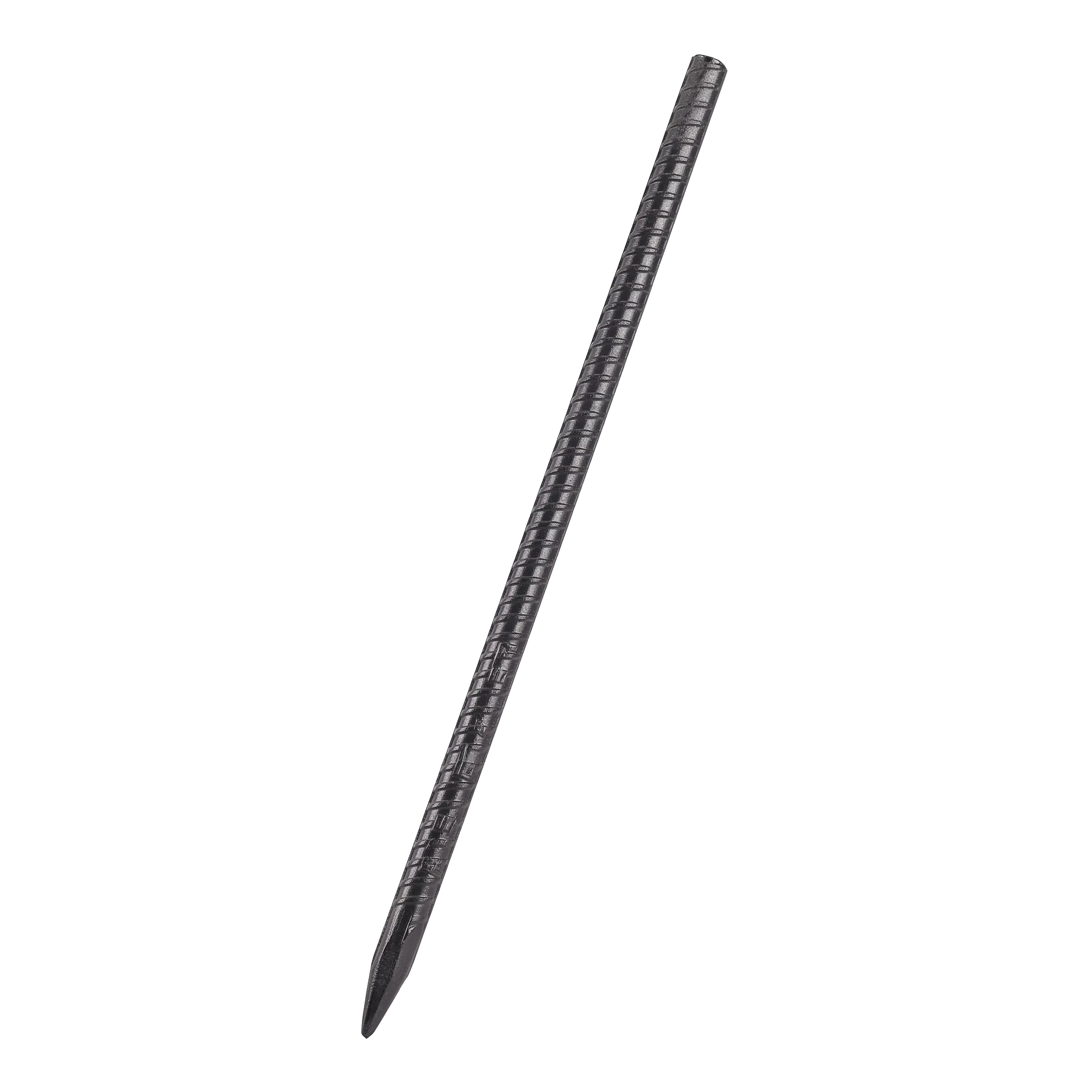
Rebar Stakes
Diameter: 5/8-1 in / 16-25 mm · Length: 16-56 in / 300-1400 mm
Specifications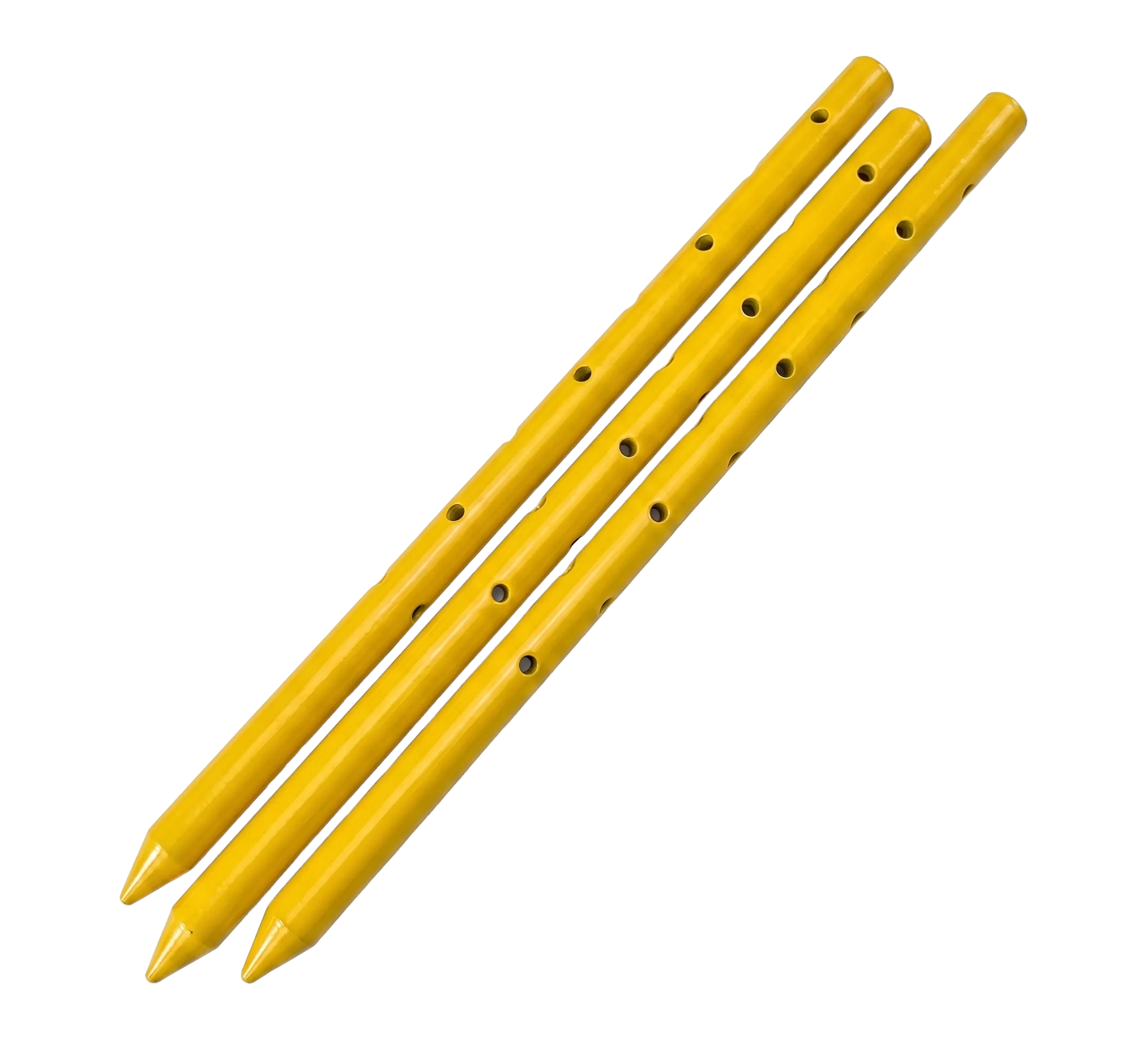
Formwork Pins
Diameter: 5/8-1 in / 16-25 mm · Length: 12-56 in / 300-1400 mm
Specifications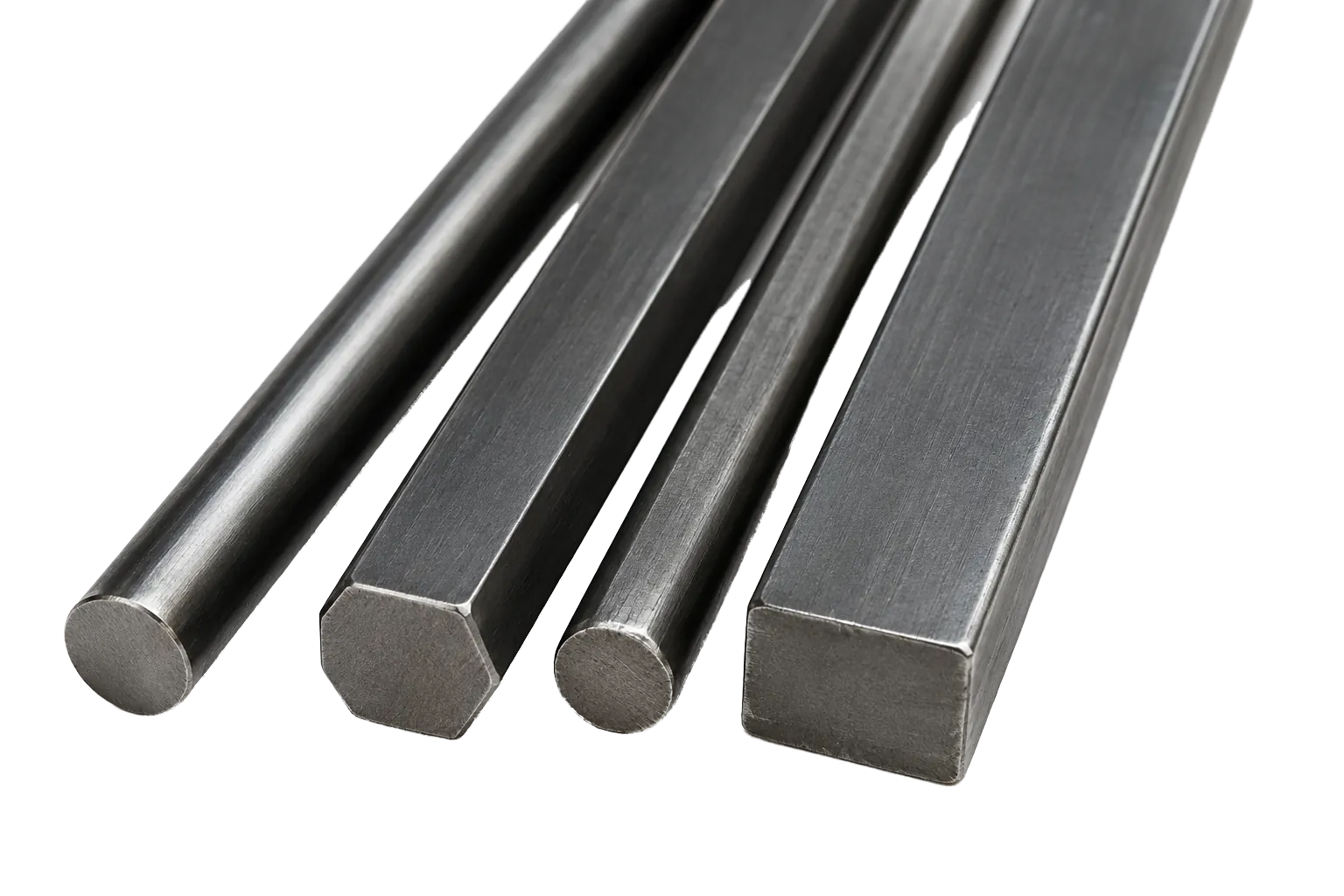
Cut Bars / Dowel Bars
Diameter (Round): 1/4-1 in / 6-25 mm · Size (Square): 5/8, 3/4, 7/8 in / 16, 18, 20 mm
SpecificationsKeep reading
Related references
References
Sources
- ICAST: SAE J403 / SAE J1397 UNS G10400, Hot Rolled — SAE J403 composition and J1397 estimated properties.
- ICAST: SAE J403 / SAE J1397 UNS G10400, Cold Drawn
- Guanyu: Mechanical properties of steel (hot rolled and cold drawn estimated minimums)
- AZoM: AISI 1040 Carbon Steel (UNS G10400) — UNS number, heat-treatment temperatures and uses.
- Interlloy: 1040 bright carbon steel bar — Relates 1040 to BS 970 080M40 (EN8).
- Smiths Metal Centres: EN8 technical datasheet — 080M40 composition and 'R' condition properties.
- Tachart: 080M40
- Roymech: EN 10083 steels for quenching and tempering — C40 / C40E composition and +N / +QT properties.
- Saarstahl material data sheet: C40E (Ck40), 1.1186 — Heat-treatment temperatures; lists BS 080M40, 080A40, 060A40 and SAE 1040.
- IS 1570 (Part 2/Sec 1):1979 Schedules for wrought steels: carbon steels (public copy)
- Total Materia: JIS S40C (JIS G 4051:2023)
- MISUMI: JIS and foreign standards comparison for machine structural steels
- Macsteel: Bright bar 080A42 (EN8D)
Values summarize published limits and typical data. The governing standard and the current edition control; check them before specifying.